Why Global Giants Want Plug-and-Play Dholera
In this story
When a global company picks a site for a new factory or data centre, it isn’t just buying land. It’s buying time. Every month spent waiting for a power connection, a water line or an approval is money lost. That is why the phrase plug-and-play infrastructure has become Dholera’s biggest selling point: roads, power, water, drainage and data links are built before investors arrive, so they can plug in and start.
Why does this matter against giants like Bangalore or Hyderabad? Because those cities are brilliant for software and services, but heavy digital and manufacturing projects have very different needs. They want space, power and speed. And that’s where Dholera competes.
So what does plug-and-play really mean, and why are global names paying attention?
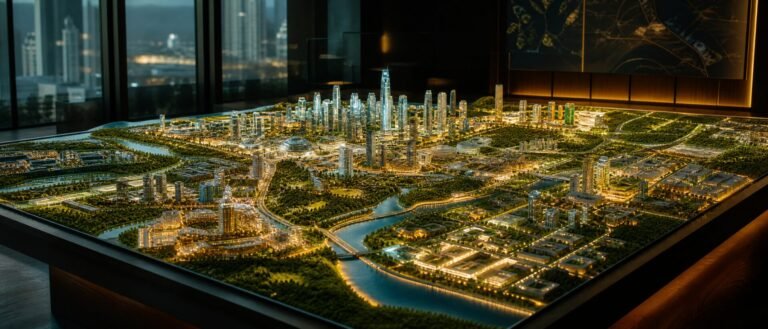
Some context first. Dholera Special Investment Region covers about 920 sq km. Its first phase, the 22.5 sq km activation area, was built infrastructure-first: more than 72 km of roads, over 138 km of storm drains, a 6.5 km canal, underground utility corridors and an integrated command and control centre, as described in Business Standard’s report.
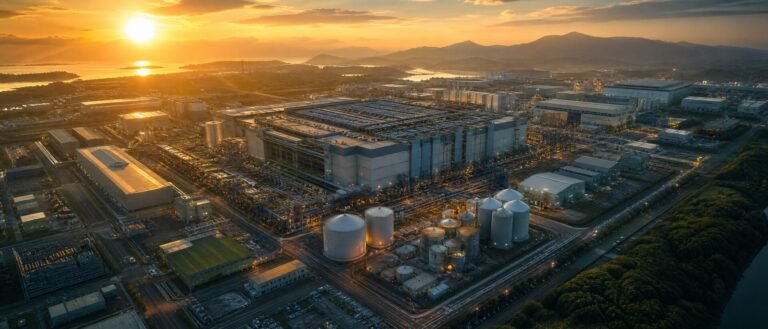
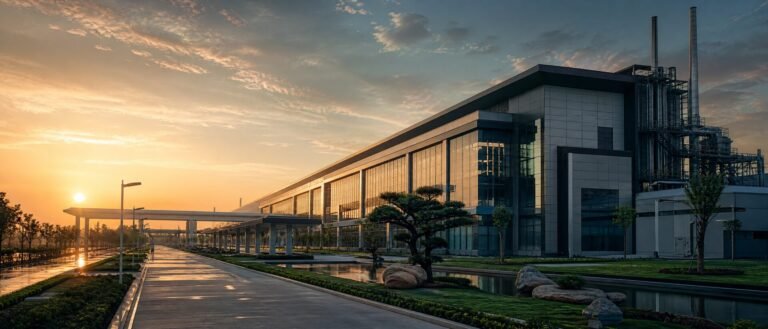
Around it, anchor investors have arrived: the Tata Electronics semiconductor fab, backed by partners like ASML and Tokyo Electron; L&T Vyoma’s planned 250 MW AI data centre; and, in August 2026, talks between Gujarat’s Chief Minister and Tillman Holdings about data centre investment in Dholera.

What Plug-and-Play Infrastructure Actually Means
In an unplanned area, a company often has to arrange its own access roads, power lines, water supply and drainage, and negotiate with several departments to do it. In a plug-and-play zone, those are already in place or planned at the plot boundary. The investor connects and builds.
- Roads: wide, finished roads up to the plot.
- Power: underground distribution with capacity planned for industry.
- Water: treated supply and a separate recycled-water network.
- Drainage: storm drains and flood protection built for the coast.
- Data: fibre ducts ready for telecom operators.
- Approvals: a single development authority, DSIRDA, handling planning inside the SIR.
The cost advantage
Dholera’s development company has said industrial power costs here are about 40% lower than in competing states, with an additional per-unit subsidy for electronics makers. Planners have also said water supply is sufficient for several semiconductor fabs. For energy- and water-hungry industries, those numbers can outweigh almost everything else.
A tale of two factories
Imagine two companies building identical factories. The first chooses an unplanned site near a big city. It spends months negotiating an access road, waits for a new power line, drills its own borewells and builds drains after the first monsoon floods the site. The second chooses a plot with plug-and-play infrastructure. Roads, power, water and drains are already at the boundary. It gets approvals from a single authority and starts construction almost immediately.
Even if both factories cost the same to build, the second one could be producing and earning months earlier. Over the life of a project, that head start can be worth far more than any difference in land price. That is the simple maths behind why global companies value plug-and-play infrastructure so highly, and why industrial regions around the world compete to offer it.
- Fewer surprises: known costs and timelines for utilities.
- Faster start: construction can begin sooner.
- Lower risk: less exposure to flooding, outages and delays.
Dholera vs Bangalore: Different Cities, Different Jobs
This isn’t a story of Dholera beating Bangalore. Bangalore is India’s software capital, with world-class talent, universities, start-ups and global offices. It will stay that way. But large manufacturing and infrastructure projects face real limits in big, mature cities:
- Land: large, flat parcels near Bangalore are scarce and expensive.
- Congestion: moving heavy equipment and goods through busy roads is slow.
- Water: Bengaluru’s severe water shortage in 2024 showed how stretched some big cities are.
- Grid capacity: adding hundreds of megawatts to an urban grid takes time.
Plug-and-play infrastructure in Dholera flips those constraints. Land is available in large, zoned plots. Roads are wide and empty. Water and power are planned for industry. The trade-off is that Dholera’s talent pool and city life are still growing, which is why partners like ASML are investing in training.
Why Global Players Are Paying Attention
Look at who has already committed, and a pattern appears:
- Chip tools: ASML and Tokyo Electron supporting Tata’s 300mm fab. Read our story on the Tata ASML partnership.
- AI infrastructure: L&T Vyoma’s ₹25,000 crore, 250 MW green data centre MoU.
- Global data centre builders: Tillman Holdings in talks with the state about Dholera.
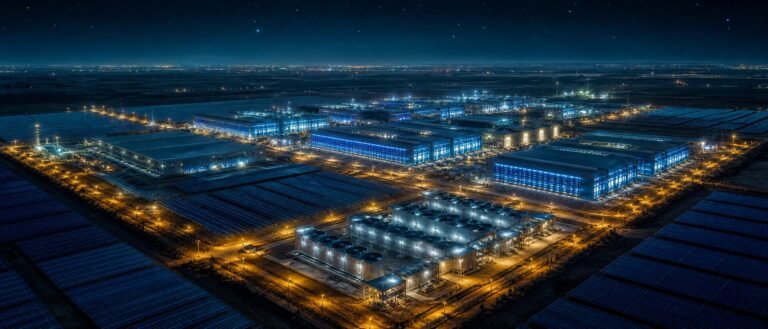
- Clean energy: a solar park planned to reach about 5 GW.
These are some of the most demanding infrastructure users in the world. They don’t choose sites lightly. Their interest suggests Dholera’s plug-and-play infrastructure is passing tough real-world tests.
What investors check before they sign
When a multinational evaluates a site, its checklist is long and unforgiving. Teams look at the reliability of the power grid, backup options and future capacity. They test water quality and ask how supply will grow. They study flood maps, road access for heavy trucks, distance to ports and airports, and how long approvals usually take. They also look at the local workforce, housing for staff and the quality of schools and hospitals for families.
A region with strong answers to most of these questions stands out quickly. Dholera’s planned utilities, single development authority, expressway and upcoming airport give it solid answers on the infrastructure side. The social side is still catching up, but it is funded and under way. That combination is why the city keeps appearing on shortlists for projects that would once have gone automatically to established hubs.
- Utilities: power, water and drainage planned for industry.
- Logistics: expressway now, airport soon, ports within reach.
- Governance: one authority for planning inside the SIR.
- People: training programmes and new social infrastructure.
Speed as a competitive weapon
In fast-moving industries like chips and AI, being six months earlier to market can decide who wins contracts. A site where utilities are ready can shave months off construction. That is why plug-and-play infrastructure isn’t just a convenience. It’s a competitive advantage.
Where plug-and-play infrastructure still has to grow
It is worth being realistic. Plug-and-play infrastructure in Dholera is fully in place in the activation area, and it is expanding into other zones in phases. Housing, schools, hospitals and leisure options for workers are still being built. Talent will take time to develop locally, which is why training partnerships matter so much. And the airport, while nearly finished, still has to open.
None of these are reasons to dismiss Dholera. They are simply the next set of milestones. The faster the social side of the city catches up with its plug-and-play infrastructure, the more attractive it becomes, not just for companies but for the people they need to hire.
What Plug-and-Play Infrastructure Means for Land Buyers
When big companies commit, jobs and demand follow: engineers need homes, suppliers need warehouses, and families need shops and schools. Plug-and-play infrastructure speeds that process up, because companies can start operating sooner.
But not every plot labelled “Dholera” sits in a serviced zone. Buyers should check whether roads, power and water are actually available near the land, or only planned. Approved, clear-title plots with real connectivity, such as Gulfin Aerocity near Pipli junction and the upcoming airport, are a more reliable bet than raw land far from infrastructure. As always, returns depend on market conditions.
Ready When You Are
Bangalore was built by talent. Dholera is being built by infrastructure. For the heavy, power-hungry industries of the next decade, that may be exactly what’s needed. Plug-and-play infrastructure lets global companies skip the hardest part of building in India and get straight to work, and every one that does makes Dholera stronger.
We share investment updates on LinkedIn and on-ground videos on YouTube.
For anyone watching Dholera, the lesson is simple: follow where infrastructure is actually ready, and where companies are actually building. Those two signals together will tell you more about the city’s future than any headline or advertisement.
Plug-and-Play Infrastructure: FAQs
What is plug-and-play infrastructure?
Industrial land where roads, power, water, drainage and data connections are already built or planned at the plot boundary, so companies can connect and start building quickly.
Is Dholera better than Bangalore?
They suit different needs. Bangalore excels at software and services thanks to its talent pool. Dholera suits large, power- and water-intensive projects that need big, serviced plots.
Which global companies are involved in Dholera?
Tata Electronics’ fab is supported by ASML and Tokyo Electron, L&T Vyoma has signed a data centre MoU, and Tillman Holdings has held talks with Gujarat about data centre investment.
Is power cheaper in Dholera?
Dholera’s development company has said industrial power is about 40% cheaper than in competing states, with an extra subsidy for electronics makers. Check current tariffs for specific cases.
Does every Dholera plot have plug-and-play infrastructure?
No. The activation area is fully serviced, while other zones are being developed in phases. Always check what infrastructure exists near a specific plot.
Follow Gulfin Developers
Site walkthroughs, Dholera updates and new launches, first on our channels.
Recent Posts